CUSTOM GLASS MICROPIPETTES
Custom Glass Micropipettes and Needles
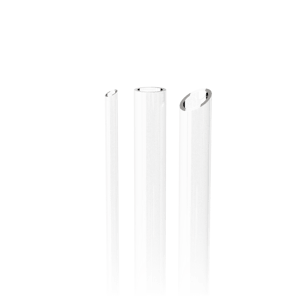
Pipettes pulled from borosilicate, aluminosilicate, or quartz glass can be modified by cutting, fire polishing, beveling, and bending in any combination to produce an exceptionally diverse array of tools.
Parts of a Micropipette
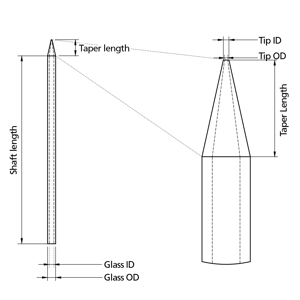
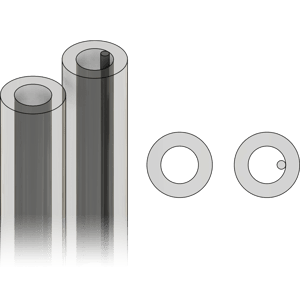
In order to specify the dimensions of your custom pipette, use this diagram to understand how Sutter Instrument refers to parts of a micropipette.
Wall Thickness
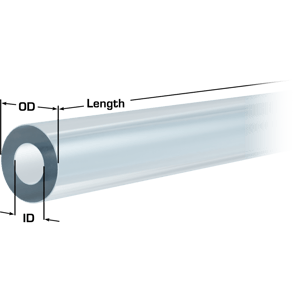
Capillary glass is roughly divided into two categories based on OD:ID ratio. Thick- or Standard-walled capillaries (the two terms are used interchangeably) refer to capillary glass having an OD:ID ratio ≥ 1.7. Thin-walled capillaries are those with an OD:ID ratio of < 1.7.
Glass Composition
BOROSILICATE
Borosilicate glass is most widely and commonly used for making micropipettes. This capillary glass is used for electrophysiology applications including patch clamp intracellular and extracellular recording. Borosilicate glass is also the preferred glass to make pipettes for mouse pronuclear and cytoplasmic injection, aspiration and transter, and holding pipettes.
ALUMINOSILICATE & QUARTZ
While Borosilicate glass is quite strong and resilient, Aluminosilicate or Quartz glass is recommended for difficult conditions and applications requiring a harder and more durable glass. In many microinjection applications, the pipette must penetrate through eggs with fibrous membranes or a hard chorion. Examples where Aluminosilicate or Quartz ipettes are preferred or required include Mosquito, Drosophila, Beetle, Moth, Butterfly, Cephalopod, Fish, Ctenophore, and Limulus eggs. Aluminosilicate and Quartz Pipettes are also often required for larvae and adult insect injections.
Uniquely among all glasses used to fabricate micropipettes, Quartz glass carries no surface charge and is therefore less prone to retain charged solutes on its surface.

Filamented vs. Non-Filamented Capillaries
You have a choice of using "filamented" or "non-filamented" capillary glass. The "filament" in the glass refers to a ~120–160 μm tiny solid rod of glass that is annealed to the inner wall of the lumen. This filament in the glass acts as a wick, creating capillary action, which allows for the easy back filling of solution into the pipette taper and tip.
Filamented glass is absolutely required for micropipettes which have a tip size less than 1 micron. Any time you are making a micropipette that has a tip at or under 3 μm, it is best to use filamented glass. Without a filament, back-filling pipettes can become difficult to impossible, and this will most often cause poor filling and introduce air bubbles within the solution of the pipette.
Cut Tips
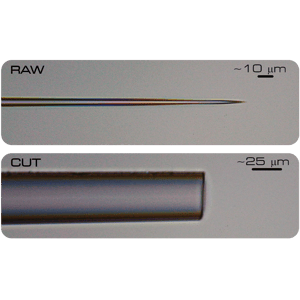
Cutting pipettes is necessary to reproducibly fabricate pipettes with tip IDs between 5 and 200 μm. It can also be used for fabricating long-tapered pipettes having tip IDs ≥ 1 μm.
In either case, the general approach is to pull a pipette with a long taper and "cut" or otherwise break the taper reproducibly at the desired ID. The methods used by Sutter Instrument in pipette fabrication produce a tip with a smooth, blunt opening.
Fire Polishing
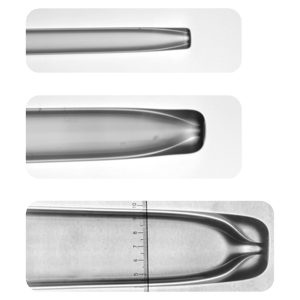
Fire Polishing is used to smooth and round the edges of a pipette. Different degrees of polish round the edges and restrict the tip ID to different extents.
Beveling
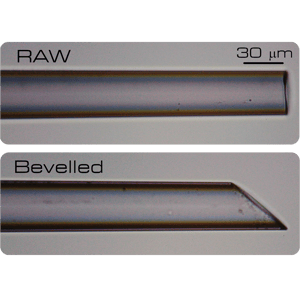
Pipette beveling is accomplished using the Sutter Instrument BV-10. Tips are beveled to hypodermic needle-like points to facilitate penetration into targets. This can be useful in multiple contexts. Beveled tips are commonly used in procedures that require penetration of single cells with minimal cellular damage.
These include:
- Intracellular Recording
- ES Cell injection
- Pronuclear Injection
- Nuclear Transfer
Bending
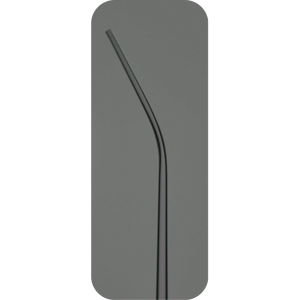
Pipettes can be bent along their taper using a microforge. This is done to accommodate otherwise impossible angles of approach between the pipette and the target.